
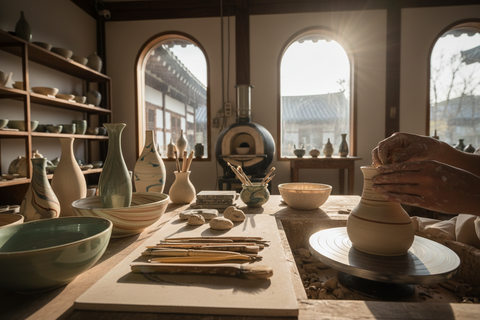
The Craft Behind the Beauty - Traditional Korean Techniques in Contemporary Context
Korean ceramic traditions stretch back thousands of years, encompassing everything from humble everyday vessels to refined celadon masterpieces that graced royal courts. At HYUNUKO, we stand within this long lineage while forging our own contemporary path. Understanding the traditional techniques that inform our work provides deeper appreciation for each piece we create.
Korean Ceramic Heritage: A Foundation of Excellence
Korean pottery has always been characterized by restraint, elegance, and a deep connection to natural materials. Unlike the ornate decoration of some ceramic traditions, Korean pottery often celebrates the inherent beauty of clay itself—its color, texture, and the subtle effects of firing.
The Joseon Dynasty (1392-1897) saw the refinement of white porcelain, known as baekja, which became synonymous with Korean aesthetic ideals. These pieces featured pure white bodies, minimal decoration, and forms that balanced functionality with sculptural grace. This philosophy—that beauty emerges from material honesty and skilled craftsmanship rather than excessive ornamentation—continues to influence Korean ceramics today.
Another significant tradition is buncheong ware, characterized by its gray-blue clay body and white slip decoration. Buncheong pieces often featured spontaneous, almost abstract patterns created through various slip techniques. This tradition's embrace of imperfection and spontaneity offers a counterpoint to the refined perfection of white porcelain, and both influences can be seen in contemporary Korean ceramics.
HYUNUKO's Approach: Honoring Tradition, Creating Anew
Our work at HYUNUKO doesn't attempt to recreate historical Korean ceramics. Instead, we draw on the principles and techniques of these traditions while creating something distinctly contemporary. The restraint and material honesty of baekja informs our minimal approach to glazing and decoration. The spontaneity and pattern-making of buncheong connects to our Nerikomi marbling technique.
We also incorporate traditional Korean firing methods, adapted for contemporary practice. While we use modern electric and gas kilns for consistency and control, we understand and occasionally employ traditional wood-firing techniques that create unique surface effects through ash deposits and flame patterns.
The Role of the Maker's Hand
In traditional Korean ceramics, the maker's hand is always present but never ostentatious. Wheel marks might be left visible on a pot's interior, showing the forming process. A glaze might be applied with deliberate irregularity, creating visual interest through variation rather than uniformity. This philosophy values the evidence of making—the piece becomes more beautiful because you can sense the human hands that shaped it.
At HYUNUKO, we embrace this principle fully. Our Nerikomi patterns are carefully planned but allow for spontaneity in execution. Our TOOBITURE furniture pieces show joinery and construction methods rather than hiding them. Our LIGHTING collection celebrates the interplay between handmade ceramic elements and functional illumination.
Material Sourcing and Preparation
Traditional Korean potters developed intimate knowledge of local clay bodies, understanding how different clays behaved and what they were best suited for. While we now have access to refined commercial clays and can source materials globally, we maintain this spirit of material knowledge.
Each clay body we use is tested extensively. We need to understand its shrinkage rate, firing temperature, color development, and how it interacts with other clays in our Nerikomi process. We blend our own clay bodies for specific applications, adjusting plasticity, color, and firing characteristics to achieve exactly what each piece requires.
The oxides and stains we use to color clay for Nerikomi work are selected for their stability and subtlety. We favor earth tones that reference natural clay colors—iron reds, manganese browns, cobalt grays—rather than bright artificial colors. This keeps our work grounded in ceramic tradition even as we push the technique in new directions.
The Firing Process: Transformation Through Fire
Firing is where clay becomes ceramic, where soft and fragile becomes hard and permanent. Traditional Korean potters understood firing as a transformative process that required skill, experience, and a degree of acceptance of the unpredictable.
Our firing process combines traditional wisdom with contemporary control. We fire slowly, allowing pieces to heat gradually to prevent thermal shock and cracking. We understand how different clay bodies and glazes mature at different temperatures and adjust our firing schedules accordingly.
For our Nerikomi pieces, firing is particularly critical. The different colored clays must fuse together seamlessly while maintaining their distinct colors. Too low a temperature and the piece will be weak; too high and the colors may blur together. Finding the perfect firing temperature for each clay combination requires extensive testing and experience.
Glazing Philosophy: When Less is More
Traditional Korean ceramics often featured subtle glazes that enhanced rather than obscured the clay body beneath. This philosophy guides our glazing approach. For Nerikomi pieces, we typically use clear glazes or leave sections unglazed, allowing the marbled patterns to remain the focal point.
When we do use colored glazes, they're chosen to complement rather than compete with the clay patterns. A soft celadon might enhance the cool tones in a piece. A transparent ash glaze might add subtle texture and depth. The glaze serves the overall composition rather than dominating it.
Contemporary Relevance of Traditional Techniques
Why do traditional techniques matter in contemporary practice? In an age where almost anything can be manufactured quickly and cheaply, handcraft techniques represent something increasingly rare—the investment of human time, skill, and attention in creating objects.
Traditional Korean ceramic techniques also embody aesthetic principles that remain relevant: restraint, material honesty, the beauty of imperfection, and the value of the maker's hand. These principles offer an alternative to the visual noise and disposability of much contemporary design.
The HYUNUKO Vision: Craft for Contemporary Life
At HYUNUKO, we believe that traditional techniques aren't museum pieces—they're living practices that can evolve and adapt. Our MONGI vessels, TOOBITURE furniture, and LIGHTING collections all demonstrate how Korean ceramic traditions can inform contemporary design without becoming mere historical recreation.
Each piece we create carries within it thousands of years of ceramic knowledge, filtered through contemporary sensibilities and applied to modern forms. This is craft that honors its past while living fully in the present—functional art that enriches daily life while connecting us to enduring traditions of making and beauty.
When you bring a HYUNUKO piece into your home, you're not just acquiring a beautiful object. You're participating in a living tradition, supporting handcraft in an age of mass production, and surrounding yourself with work that will remain meaningful for generations to come.