
TOOBITURE - Reimagining Furniture Through the Lens of Ceramic Artistry
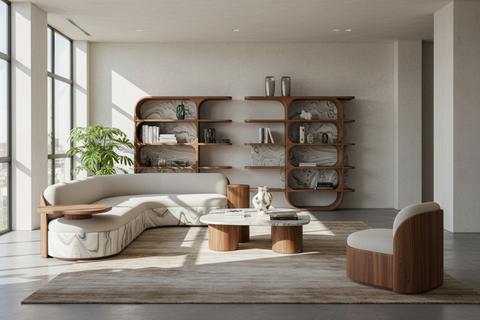
Furniture design has long been dominated by wood, metal, and upholstery. But what happens when the sensibilities of ceramic artistry meet the functional demands of contemporary furniture? The answer is TOOBITURE—HYUNUKO's revolutionary approach to designer furniture that integrates marbled porcelain elements with structural design to create pieces that blur the boundaries between furniture and sculpture.
The Philosophy Behind TOOBITURE
TOOBITURE emerged from a simple question: why should the artistry of Nerikomi marbled porcelain be confined to vessels and decorative objects? The technique's visual richness and tactile appeal seemed perfectly suited to larger-scale applications, yet few makers had explored this territory. We saw an opportunity to pioneer a new category of functional art—furniture that carries the soul of handcrafted ceramics.
The name TOOBITURE itself reflects this hybrid nature, combining references to traditional Korean ceramic techniques with the structural language of furniture design. Each piece in the collection represents a dialogue between these two disciplines, asking how ceramic elements can enhance, support, and transform furniture forms.
Design Principles: Where Form Meets Function
Creating furniture with ceramic components presents unique challenges. Ceramics are inherently fragile compared to traditional furniture materials, yet they offer unmatched aesthetic possibilities. Our design process begins with rigorous consideration of structural integrity—where will weight be distributed? How can ceramic elements be supported? What role will they play in the overall stability of the piece?
We've developed proprietary techniques for integrating marbled porcelain into furniture frames, creating hybrid structures where ceramic and other materials work in harmony. A TOOBITURE table might feature a base of marbled porcelain, its swirling patterns creating visual movement, supported by a carefully engineered internal structure. A seating piece might incorporate ceramic elements as armrests or decorative panels, their cool smoothness contrasting beautifully with warm wood or soft upholstery.
The Intersection of Craft Traditions
TOOBITURE pieces draw on multiple craft lineages. From Korean furniture traditions, we inherit principles of proportion, joinery, and the relationship between furniture and living space. From ceramic arts, we bring pattern, texture, and the transformative power of fire. From contemporary design, we embrace minimalism, functionality, and the idea that beautiful objects should enhance daily life.
This intersection creates something entirely new. A TOOBITURE piece doesn't look like traditional Korean furniture, nor does it resemble conventional ceramic sculpture. Instead, it occupies its own category—contemporary, handcrafted, and unmistakably unique.
The Making of a TOOBITURE Piece
Creating a TOOBITURE furniture piece is an extended process that can take weeks or even months. It begins with conceptual sketches that explore how ceramic elements might integrate with structural components. These sketches evolve into detailed technical drawings that address both aesthetic and engineering concerns.
The ceramic components are created using our Nerikomi marbling technique, with patterns designed specifically for each furniture piece. These elements are formed, dried, and fired with the same care as our MONGI vessels, but with additional considerations for how they'll interface with other materials.
Simultaneously, structural components are fabricated—whether wood, metal, or composite materials. These are crafted with furniture-making precision, ensuring proper joinery, finish, and durability. The final assembly brings these elements together, often requiring custom hardware and innovative attachment methods.
Each TOOBITURE piece undergoes rigorous testing to ensure it meets our standards for both beauty and functionality. A chair must be comfortable and stable. A table must support weight without flexing. A cabinet must open smoothly and protect its contents. We never compromise function for aesthetics—both must be exceptional.
Living with TOOBITURE
TOOBITURE furniture transforms living spaces in unexpected ways. The marbled porcelain elements catch and reflect light throughout the day, creating subtle shifts in appearance as natural light changes. The tactile quality invites interaction—running your hand across a smooth ceramic surface becomes a small daily pleasure.
These pieces work beautifully in contemporary interiors, where their clean lines and sophisticated patterns complement minimalist aesthetics. They also create striking contrasts in more traditional spaces, serving as conversation-starting focal points. Because each piece is one-of-a-kind, owning TOOBITURE furniture means your space contains something that exists nowhere else.
Sustainability and Longevity
In an era of disposable furniture and fast design, TOOBITURE represents a different philosophy. These are heirloom pieces, built to last generations. The ceramic components are essentially permanent—properly cared for, they'll look the same in a hundred years as they do today. Structural components are selected for durability and, when possible, sustainability.
We believe in creating less, but creating better. Each TOOBITURE piece represents significant investment of time, skill, and materials. In return, owners receive furniture that will never go out of style, never need replacing, and can be passed down as treasured family pieces.
The Future of Furniture as Art
TOOBITURE challenges conventional categories. Is it furniture? Is it sculpture? Is it craft or fine art? We believe these distinctions matter less than the experience of living with beautiful, functional objects that enrich daily life.
As we continue developing the TOOBITURE collection, we're exploring new forms, new material combinations, and new ways of integrating ceramic artistry into functional design. Each piece teaches us something new about what's possible when traditional techniques meet contemporary vision. This is furniture reimagined—not just as utility, but as art you can live with.